
Potty training a Golden Retriever puppy can feel far more complicated than it actually is, particularly when you’ve just cleaned up one accident and somehow discover another five minutes later. The good news is that Goldens are typically quick learners. The slightly less convenient news is that they’re also excitable puppies who can become distracted by almost anything, so sometimes the difficult part isn’t teaching them where to go; it’s getting them outside and focused long enough to remember why they’re there.
Professional dog trainer and behavior consultant Ali Smith has a very straightforward approach to toilet training: reduce the opportunity for mistakes, learn your puppy’s signals, give them plenty of appropriate chances to go outside, and reward them well when they get it right.
“Your puppy isn’t special, different, difficult, stubborn or stupid. They’re simply a puppy learning what we want.”
That’s worth remembering, because toilet training is one of those areas where frustration can very quickly turn into blaming the puppy. In reality, we’re the ones who have decided that the kitchen floor is unacceptable but the grass six feet away is perfect. Our job is to make that distinction clear enough for a baby dog to learn.
How Long Does It Take to Potty Train a Golden Retriever Puppy?
There isn’t a particularly useful answer to this because puppies develop at different rates. Some Goldens understand the basic idea remarkably quickly, while others take longer to become consistently reliable. Even a puppy who clearly knows that toileting belongs outside can still have accidents because bladder control, communication and the ability to interrupt whatever exciting thing they’re doing are still developing.
Rather than worrying about whether your puppy should be fully potty trained by a particular age, look for progress. Accidents should gradually become less frequent, you should start recognizing your puppy’s signals more easily, and they may begin deliberately heading toward the door or seeking you out when they need to go.
Start by Preventing as Many Accidents as Possible
The least glamorous part of successful potty training is supervision. When your Golden Retriever puppy is awake and has freedom in the house, somebody needs to have a reasonably good idea of what they’re doing. Young puppies are not particularly good candidates for disappearing quietly into another room while you assume everything is fine.
“Minimise the opportunity for error and reward getting it right. That’s the shortest way to successfully toilet train a puppy.”
Every time you notice that your puppy needs to go and get them outside in time, you’ve created another opportunity to reinforce the behavior you want. This same combination of observation, prevention and immediate reinforcement is also recommended in the American Veterinary Society of Animal Behavior’s housetraining guidance.
When your puppy is asleep, you can relax your supervision. When you genuinely can’t watch them, sensible management can help limit how much freedom they have. Ali also has a useful guide to umbilical cord training with puppies, a management technique that can make close supervision much easier.
When Should You Take a Golden Retriever Puppy Outside?
Instead of relying exclusively on arbitrary timers, build toilet breaks around the things that predictably trigger a puppy’s need to go. Take your puppy out after sleeping, eating, drinking and playing, while offering sensible additional opportunities in between according to the individual puppy.
Learn What Your Puppy Does Before They Need to Go
Common signs include intense sniffing, circling, pacing, squatting, seeking attention and an abrupt change in behavior. If your Golden has been bouncing around with a toy and suddenly wanders away with their nose glued to the carpet, I wouldn’t wait around to see how the story ends. Take them outside.
The important thing is not to assume every puppy reads the same instruction manual. Ali emphasizes that owners need to become observant enough to recognize their own puppy’s pattern. Once you know their signals, toilet training becomes considerably less mysterious.
Reward Toileting Outside Properly
When your puppy toilets outside, make it worthwhile. Ali likes to praise first and then deliver the reward quickly. Food is usually a very practical option for a Golden Retriever, although play can also be reinforcing. Early on, make the connection obvious; AVSAB likewise stresses that rewards should follow successful outdoor toileting immediately rather than waiting until the puppy is back indoors.
Do You Need to Teach a “Go Potty” Cue?
A lot of toilet-training advice recommends attaching a verbal cue to the behavior. There’s nothing inherently wrong with teaching one, but Ali deliberately chooses not to.
“Dogs have so much dictated to them already. Giving them the freedom to pee whenever they want, so long as they’re outside, seems fair to me.”
For most Golden Retriever owners, the important criterion is that their dog understands where toileting is appropriate. Toileting on cue is a separate training goal, not a requirement for successful house training.
What If Your Golden Retriever Puppy Won’t Pee Outside?
Goldens can become distracted outside by grass, birds, sticks and apparently every other feature of the natural world. If your puppy is struggling to get on with the job, Ali suggests introducing a little movement, which can help stimulate the bowel and bladder. If nothing happens, try again shortly. If you return indoors without success, supervise particularly closely because the need to toilet hasn’t disappeared simply because you crossed the threshold.
Don’t Automatically End Outdoor Time the Moment They Go
If every successful pee immediately causes you to march your puppy back into the house, a puppy who loves being outside can learn that toileting ends the fun. Whenever practical, let them sniff, explore or play a little after they’ve gone so outdoor access itself can become part of the reward.
What Should You Do If Your Puppy Has an Accident Indoors?
Clean it up. That’s really all the drama the situation needs. Ali’s view is that most toilet-training mistakes should be treated as information for the human rather than wrongdoing by the puppy.
“We made the rules. We’re teaching those rules to a student who doesn’t speak English and has a significantly lower IQ than we do.”
Think about what happened beforehand: had your puppy just woken up, had somebody missed their signal, were they given too much freedom, or had it simply been too long? That gives you something useful to change next time.
Should You Punish a Golden Retriever Puppy for Peeing Indoors?
No. Punishment doesn’t reliably explain what you wanted the puppy to do instead and can teach them that toileting in front of you is dangerous. AVSAB specifically warns against punishing housetraining accidents because puppies may instead learn to sneak away to urinate.
If you catch your puppy beginning to toilet, calmly get them outside if practical. If you discover an accident afterward, clean it thoroughly and adjust your management.
Should You Restrict Water to Help Potty Training?
I wouldn’t use water restriction as a toilet-training shortcut. Puppies need access to fresh water, and how much they drink naturally varies with food, activity, weather and the individual dog. Ali explores this question in detail in Should You Restrict Your Puppy’s Water for Toilet Training?, where she recommends focusing on routine and reinforcement rather than withholding water.
Should You Wake a Golden Retriever Puppy for Potty Trips Overnight?
Ali’s answer is simple: not unless there’s a reason to. If your puppy sleeps comfortably and wakes or alerts you before an accident, there’s little benefit in disturbing them simply because a generic schedule says you should.
Sleep is extremely important for puppies, particularly excitable Goldens. Our Golden Retriever puppy sleep and settling guide looks specifically at sleep needs, regulation and when waking a sleeping puppy may actually make sense, while Ali’s puppy sleep schedule and age-by-age guide goes deeper into puppy sleep and nighttime routines. If your individual puppy routinely has an accident before waking or signaling, temporarily getting ahead of that predictable time can make sense; otherwise, if everybody is happily asleep and the system works, let the puppy sleep.
You Don’t Need a Crate to Potty Train a Puppy
Crates can be useful management tools for some households, but they aren’t compulsory. Ali considers crate training optional for all dogs, including Golden Retrievers. If you decide a crate suits your household, her guide to teaching a puppy to love their crate explains how to introduce one positively.
The foundations of toilet training remain the same with or without a crate: supervision, regular appropriate opportunities, observation and meaningful reinforcement.
Why Is My Golden Retriever Puppy Suddenly Having Accidents Again?
Regression usually feels much more dramatic to us than it actually is. Before deciding everything has unraveled, look at whether your expectations or management changed.
Rewards disappeared too quickly
Don’t be in too much of a hurry to stop rewarding a behavior that is still being learned.
The criteria changed too quickly
A puppy who toilets outside when you take them out hasn’t necessarily learned to independently interrupt play, find you, signal and wait for the door to open. Those are additional skills.
Your puppy got too much freedom
Success in one part of the house doesn’t automatically mean your puppy is ready for unrestricted access everywhere.
Expectations increased too quickly
The fact that your puppy managed a longer interval once doesn’t mean their body is reliably capable of doing it every day. If things slip, make the process easier again rather than interpreting it as defiance.
When Toileting Problems Need a Vet, Not More Training
If a previously reliable puppy suddenly starts urinating unusually frequently, strains, seems uncomfortable, develops diarrhea, drinks noticeably more than usual or shows another concerning change, speak to your veterinarian. Training can’t resolve a urinary tract infection, digestive upset or another medical problem.
What Does a Good Golden Retriever Puppy Potty-Training Routine Look Like?
I wouldn’t give every Golden owner the same minute-by-minute schedule. Instead, create a predictable rhythm around the events you know increase the chance your puppy needs to go: sleep, food, water and play. Add regular opportunities while they’re awake, watch for their own signals and reward outdoor toileting generously. Over time the gaps naturally become longer and your puppy becomes better at communicating with you.
Golden Retrievers Usually Learn Quickly — Our Consistency Is Often the Harder Part
Toilet training is simple, but that doesn’t mean it’s always easy. It requires attention when you’re probably tired and adjusting your entire routine. The encouraging part is that Goldens generally learn very well when the rules are clear.
As Ali puts it, the aim is to minimise the opportunity for error and make getting it right pay well. That principle is far more useful than any magic schedule.
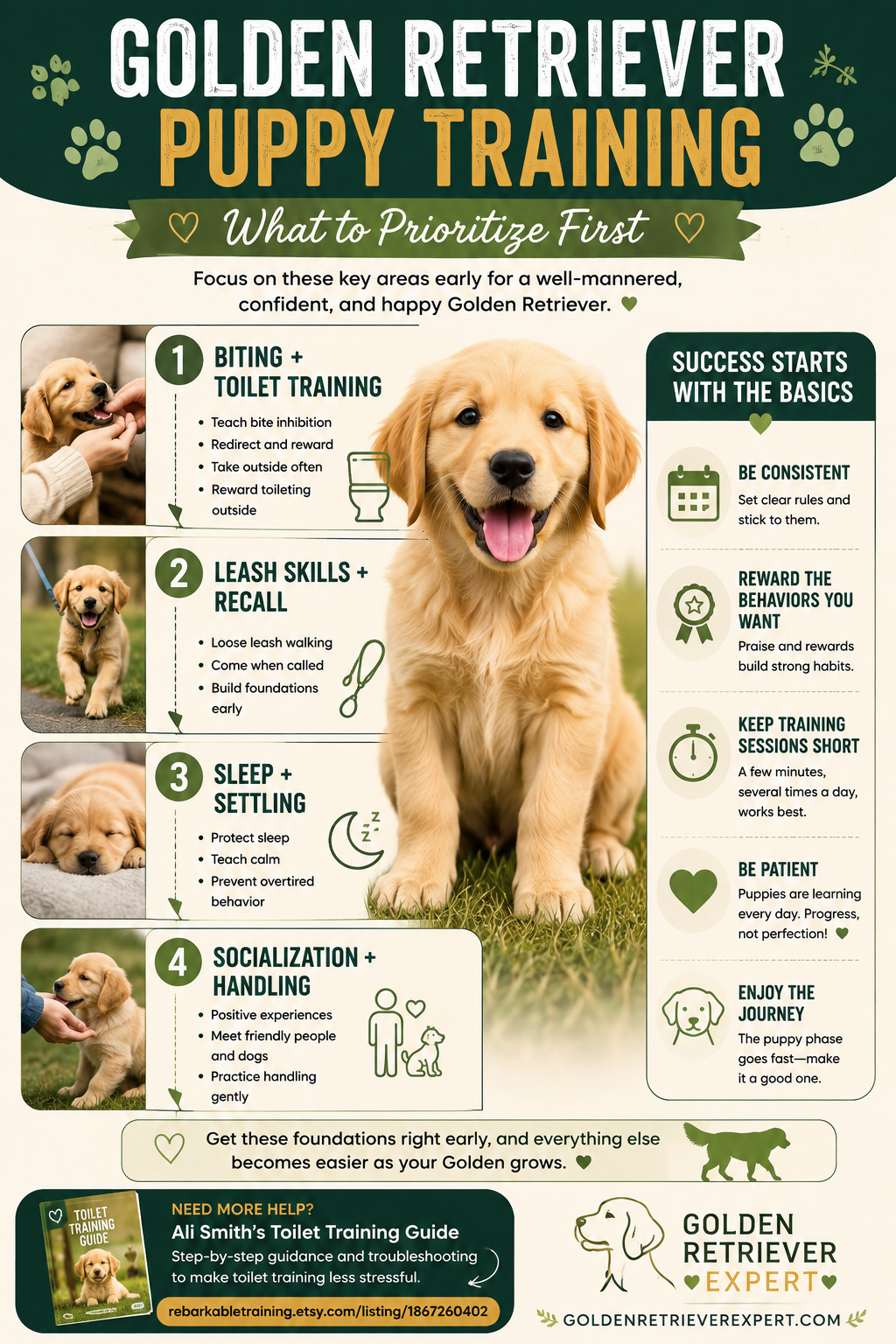
Toilet training is only one part of those hectic first months. Our Golden Retriever Puppy Training: A Complete Guide covers the other skills worth prioritizing early, including biting, leash work, recall, sleep and socialization.
If toilet training is currently proving particularly frustrating, Ali has also created a more detailed Toilet Training Guide with practical help and troubleshooting.
Your puppy isn’t plotting against the carpet. They’re learning a rule that matters enormously to us and meant absolutely nothing to them when they arrived. Give them a fair chance to learn it.