
Golden Retrievers have a bit of a reputation for being the easy option.
They’re smart, friendly, famously trainable and usually pretty keen to work with their humans. So you bring home this gorgeous fluffy puppy expecting cuddles and easy-peasy puppy training.
And then it bites you.
And bites your sleeve.
And hangs from your pants.
And tries to eat the chair.
Welcome to Golden Retriever puppyhood.
Professional dog trainer and behavior consultant Ali Smith says this mismatch between expectation and reality catches a lot of new Golden owners out.
“People expect Goldens to be all cuddles and easy-peasy. They are typically very smart dogs, but they’re still puppies — and they can be extra bitey because they’re such a mouth-oriented breed.”
The good news is that Golden Retrievers really are capable learners. But raising a well-mannered Golden isn’t about teaching an impressive list of commands as quickly as possible.
There are a handful of skills that will make a much bigger difference to everyday life.
When Should You Start Training a Golden Retriever Puppy?
As soon as your puppy comes home.
That doesn’t mean your eight-week-old puppy needs formal obedience sessions. In fact, they’re already learning whether you deliberately “train” them or not.
They’re learning where they go to the bathroom. What happens when they bite your hands. Whether coming toward you is worthwhile. How humans respond when they steal something. Whether being handled feels safe. What happens when they see another dog.
All of that is training.
Keep deliberate sessions short and easy, particularly with a very young puppy. Thirty seconds here and there throughout the day can be far more productive than trying to keep a baby dog focused for a long formal training session.
What Should You Teach a Golden Retriever Puppy First?
It’s tempting to start with sit, down, paw and all the things we traditionally associate with a “trained” dog.
But those wouldn’t be Ali’s priorities.
For a young Golden Retriever, she puts biting and toilet training right at the top of the list, followed by leash skills and recall.
That makes sense when you think about the adult dog you’re raising.
A cute Golden puppy becomes a large, powerful and extremely sociable dog surprisingly quickly. Teaching the skills that make everyday life easier while your puppy is small pays off enormously later.
So our early priorities are:
- Managing puppy biting and teaching appropriate things to bite and chew
- Toilet training
- Building good leash skills
- Developing a strong recall
- Learning to settle and get enough sleep
- Positive handling and grooming
- Thoughtful socialization
- Gradually learning independence
Your puppy can absolutely learn sit too. It just isn’t the thing I’d lose sleep over.
Speaking of sleep…
Please Don’t Try to Exhaust Your Golden Retriever Puppy
One of the easiest traps to fall into with an excitable puppy is assuming that more activity will produce a calmer puppy.
Sometimes it produces exactly the opposite.
“Don’t fall for it,” Ali says. “Sleep is one of the most underrated things for all puppies, but with excitable Golden Retrievers it can be a big issue.”
An overtired puppy can become increasingly frantic, mouthy and apparently incapable of listening. It’s very easy to look at that behavior and think, Wow, this puppy still has so much energy. I need to tire them out.
So you add another walk. Another play session. Another exciting activity.
Now you have an even more exhausted puppy who is even less capable of regulating themselves.
Rest needs to be part of your Golden Retriever puppy’s routine. Our Golden Retriever puppy sleep and settling guide covers overtiredness, naps, regulation and teaching a puppy to switch off in much more detail.
Give your puppy somewhere comfortable and relatively boring to sleep. Build quiet periods into the day. And when biting or wild behavior suddenly seems to go through the roof, ask yourself when your puppy last had a decent nap before automatically reaching for another activity.
Learning to switch off is a skill too. Ali goes deeper into this in her puppy sleep schedule and age-by-age guide, including how much sleep young puppies typically need and how to build rest into the day.
Golden Retriever Puppy Biting Is Normal — But Goldens Can Be VERY Mouthy
There’s puppy biting, and then there’s living with a baby retriever.
Golden Retrievers have been selectively bred to use their mouths, so it shouldn’t be particularly surprising when Golden puppies are enthusiastic about putting things in them.
Unfortunately, those things frequently include us.
The first thing to consider when biting suddenly becomes intense is whether your puppy needs sleep. If their needs are met and they are simply looking for something to mouth, Ali recommends redirecting them onto an appropriate toy.
But there’s an important detail here that often gets missed: match the texture.
If your puppy is obsessed with grabbing something soft and fabric-like, handing them a hard chew may not satisfy what they were looking for.
Likewise, as Ali puts it:
“Replacing a chair leg with a bone isn’t necessarily going to do it.”
Try to understand what your puppy is getting from the thing they chose and offer a legal alternative that provides a similar experience. For a free walkthrough of the same overall approach, see Ali’s trainer guide to teaching a puppy not to bite.
This is a much bigger subject than we can sensibly squeeze into one section. Start with our dedicated Golden Retriever puppy biting guide for the full breed-specific walkthrough. If you’re currently living with a tiny Golden land shark and want more detailed troubleshooting, Ali has also created a Puppy Biting Guide.
Toilet Training a Golden Retriever Puppy
The basic principles of toilet training a Golden are much the same as they are for other puppies.
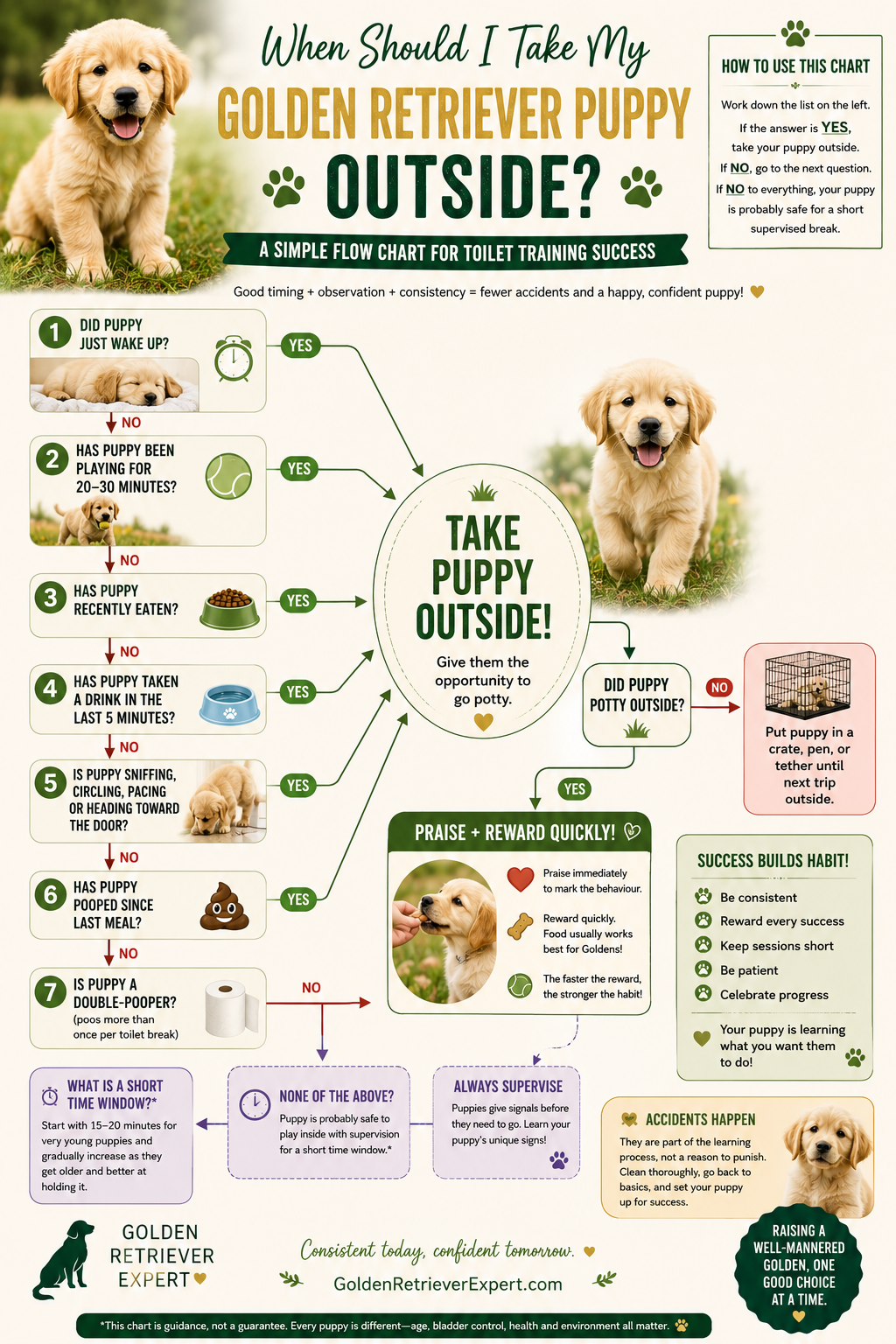
Take them outside frequently, particularly after waking, eating, drinking and playing. Pay attention to their individual patterns and reward them when they toilet in the appropriate place.
Golden Retrievers can be excitable, which sometimes makes getting outside and actually concentrating on the job slightly more interesting than you’d like.
The upside?
They tend to be quick learners.
Consistency matters far more than punishment. If your puppy has an accident indoors, clean it thoroughly and consider what needs changing in your routine or management.
Did they have too much freedom?
Did you miss the signs?
Was it simply too long since their last opportunity?
An accident doesn’t require a telling-off. It tells you something about what your puppy was ready to manage.
We cover the whole process step by step in our Golden Retriever puppy potty-training guide, including when to take your puppy outside, how to reward successful toileting and what to do about accidents and regression.
Start Leash Training While Your Golden Retriever Is Small
Please don’t wait until your Golden is strong enough to tow you down the sidewalk before deciding leash manners might be useful.
Golden Retrievers grow quickly.
The wonderful thing is that they can start learning good leash skills when they’re very young.
“They really can master it very young,” Ali says, “and without punishment.”
You don’t need to rely on leash corrections to teach a Golden Retriever to walk nicely. That reward-based approach also lines up with guidance from the American Veterinary Society of Animal Behavior, whose public resources include position statements on humane training methods and puppy socialization.
Start somewhere easy, reward your puppy for being near you and for creating slack in the leash, and gradually increase the difficulty as their skills develop.
Don’t expect a young puppy who can walk beautifully around your kitchen to immediately reproduce that behavior beside a busy park full of dogs, people and fascinating smells.
And remember that walks aren’t obedience competitions. Your puppy should be allowed to sniff and investigate their environment too.
We’re aiming for a dog who can move through the world with you comfortably, not one who spends every walk glued mechanically to your leg. Our Golden Retriever puppy leash-training guide takes you through that process from day one, including what to do when the leash tightens and how to handle the classic Golden urge to greet everybody.
Recall Is Especially Important for a Very Friendly Golden
People often describe Golden Retrievers as dogs who want to be everyone’s friend.
That’s lovely.
It’s also something you need to train around.
Your dog does not have an automatic right to approach every person or dog simply because their intentions are friendly.
In fact, an extremely enthusiastic Golden can be quite overwhelming to other dogs.
Dogs often use curved approaches and other body language to reduce social pressure. A Golden who gets wildly excited, runs directly toward another dog and barrels straight into their personal space can come across as confrontational or rude — even if your Golden genuinely only wants to say hello.
As Ali explains, responsible ownership means not allowing friendliness to become uncontrolled access to everybody else.
That’s one of the reasons recall matters so much.
Start while your puppy naturally wants to stay close.
Reward them generously for coming toward you. Practice when success is easy rather than repeatedly testing your recall around distractions your puppy isn’t ready to handle.
And don’t only call your puppy when the fun is about to end.
Sometimes call them, reward them brilliantly and release them straight back to whatever they were enjoying.
You want hearing their recall cue to feel like excellent news. Our Golden Retriever puppy recall training guide takes you through building that response from easy indoor recalls through long-line work and real-world distractions.
Socialization Doesn’t Mean Meeting Everyone
This follows naturally from recall.
A well-socialized Golden Retriever isn’t necessarily a puppy who has greeted 100 people and played with 50 dogs.
Socialization is about helping your puppy learn that the world is safe and manageable.
Sometimes that means interacting.
Sometimes it means observing.
Your puppy can see another dog without meeting them. They can watch children playing without being mobbed by them. They can experience traffic, different surfaces, noises, grooming equipment, visitors and new environments without every experience becoming a huge event.
In fact, for a naturally sociable Golden, learning that the presence of another dog doesn’t always predict a greeting is extremely useful. Our dedicated Golden Retriever puppy socialisation guide goes much further into building neutrality, choosing good exposures and knowing when to walk away.
Quality matters more than collecting as many interactions as possible. If you want the veterinary-behavior perspective too, AVSAB also publishes a dedicated puppy socialization position statement.
Do You Have to Crate Train a Golden Retriever?
No.
Crates can be useful management tools for some families and some dogs, but crate training is optional.
That’s true for Golden Retrievers and it’s true for dogs generally.
If you decide to use one, introduce it positively and gradually. The goal should be for your puppy to feel comfortable and safe there rather than simply learning that escape isn’t possible.
If a crate doesn’t suit your puppy or household, there are other ways to create safe puppy areas and manage the environment.
A crate is a tool, not a requirement for raising a well-trained dog. The same principle applies when teaching independence: our Golden Retriever puppy home-alone guide covers building tiny, successful separations with a crate, pen or other safe setup.
Teach Your Puppy How to Give Things Up
You have a retriever.
Things are going to end up in their mouth.
Rather than turning every stolen sock into an international hostage negotiation, start teaching your puppy that humans approaching their treasures is good news.
Swapping can be incredibly useful.
Offer something worthwhile in exchange for the item rather than routinely chasing, grabbing or forcing things out of your puppy’s mouth.
And use management.
If your puppy steals the same shoe every morning, putting the shoe away while you work on training isn’t cheating. It prevents your puppy from repeatedly practicing a behavior you don’t want.
Handling and Grooming Are Training Too
Your fluffy puppy is going to become a very fluffy adult.
Golden Retrievers need regular coat care, and they’ll also need nail care, ear checks, veterinary examinations and general handling throughout their lives.
Don’t wait until you desperately need to trim a nail or inspect an ear before introducing those experiences.
Practice tiny pieces of handling when nothing needs to be done.
Touch a paw, reward.
Briefly look at an ear, reward.
Introduce the brush gradually.
Let your puppy learn that handling is predictable and safe.
Whenever possible, give them some agency in the process rather than relying on restraint simply because they’re currently small enough to hold still.
What Should a Golden Retriever Puppy Know by Six Months?
I wouldn’t judge a six-month-old Golden Retriever against a rigid obedience checklist.
They don’t need to perform a dozen cues perfectly to prove that training is going well.
I’d much rather see useful foundations.
Can you communicate with each other?
Is toilet training progressing well?
Is the biting becoming manageable?
Has your puppy started developing leash skills before they become physically difficult to control?
Are you building a recall?
Can your puppy settle and sleep?
Can they experience another dog without assuming they must immediately charge over and make friends?
Are handling and grooming becoming normal parts of life?
Those skills will matter far more than an impressive party trick.
And remember that adolescence is coming. Development isn’t linear. A puppy who appears beautifully trained at five months may suddenly discover at eight months that the rest of the world is much more interesting than you are.
That doesn’t mean you’ve failed.
It means you’re raising a developing animal, not programming a machine.
Common Golden Retriever Puppy Training Mistakes
Assuming Smart Means Easy
Golden Retrievers tend to be clever and trainable.
They’re also excitable, social, mouthy puppies.
Both things can be true.
Being intelligent doesn’t mean your puppy arrives knowing how humans expect dogs to behave.
Prioritizing Commands Over Life Skills
Sit is lovely.
Not biting your arms, toileting outside, walking without dragging you over and coming back when called are lovelier.
Prioritize the skills that affect everyday life.
Trying to Tire Them Out
More exercise is not always the answer to difficult puppy behavior.
Before adding stimulation, consider whether your puppy actually needs rest.
Waiting to Work on Leash Skills
Your Golden won’t stay tiny for long.
Take advantage of the period when they’re physically easy to manage and start teaching them how you’d like walks to work.
Letting Them Greet Everybody
Friendly isn’t the same as polite.
Your Golden Retriever needs to learn that seeing another person or dog doesn’t automatically mean they get to rush over and interact.
Expecting Too Much Too Quickly
Your puppy has only been alive for a few weeks or months.
Training can teach skills remarkably quickly. Maturity takes longer.
A Simple Golden Retriever Puppy Training Routine
You don’t need to schedule hour-long obedience sessions.
Training can happen throughout normal life.
Use breakfast to practice a few easy skills. Reward your puppy when they voluntarily check in with you. Practice recall between rooms. Work on a few moments of loose-leash walking somewhere boring. Reward calmness when it happens naturally. Practice brief handling. Take regular toilet trips outside.
Then let your puppy sleep.
The aim isn’t to spend every waking minute training them.
It’s to create lots of tiny opportunities for your puppy to discover that the behaviors you like work really well for them.
The Goal Isn’t a Perfect Puppy
Your Golden Retriever puppy is going to make mistakes.
So are you.
The goal of puppy training isn’t to eliminate every inconvenient behavior as quickly as possible. It’s to build communication, useful skills and enough trust that you can navigate those mistakes together.
Start with the things that actually matter.
For Golden Retrievers, that means getting on top of biting and toilet training, building leash skills before your puppy becomes a large adolescent, starting recall early and teaching your extremely friendly dog that they don’t need to greet everybody they see.
Give them enough sleep.
Let them be a puppy.
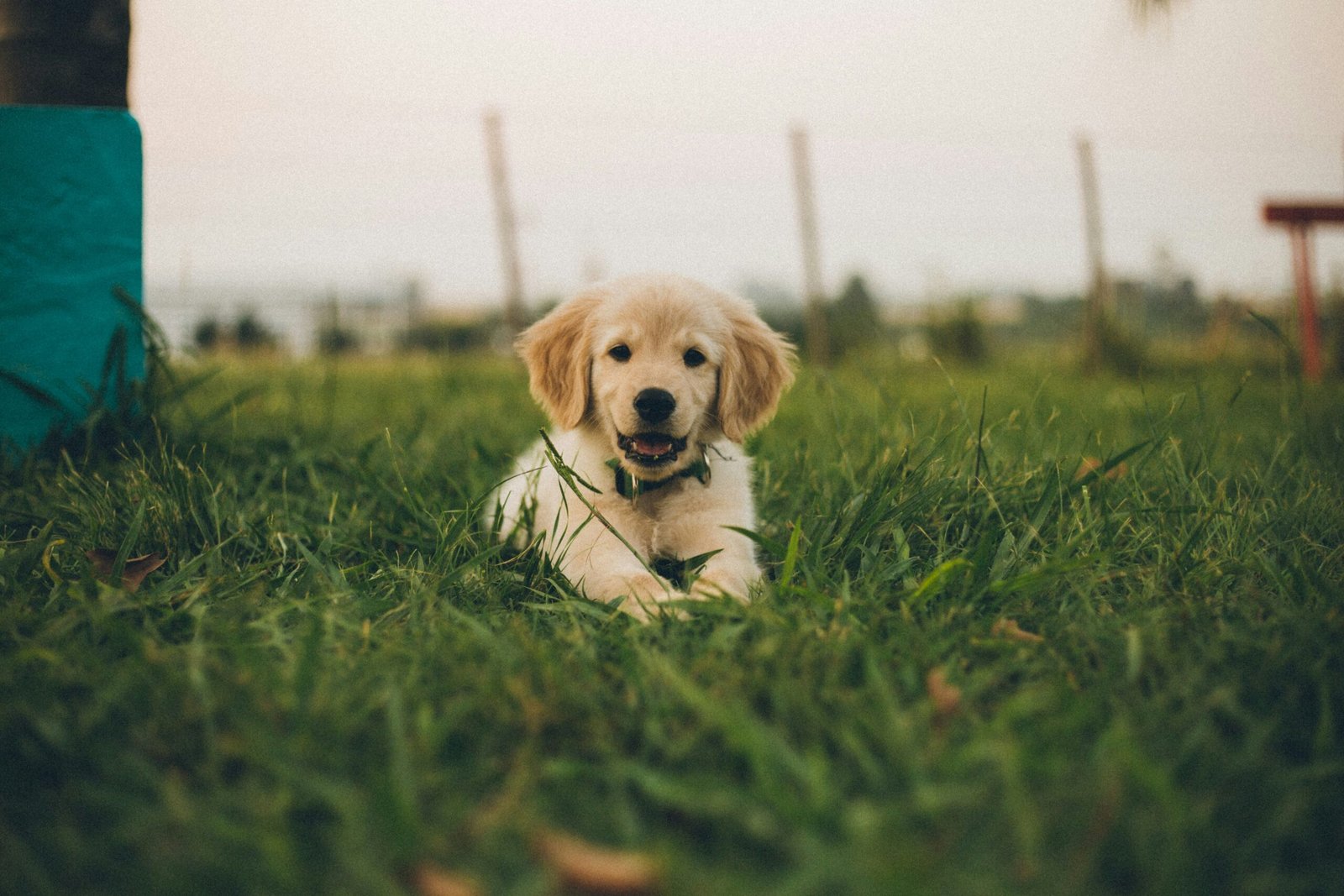
And don’t be fooled by that innocent Golden Retriever face.
There’s a very good chance they’re already thinking about putting something inappropriate in their mouth.
For more breed-specific background while you’re getting to know your puppy, you may also find our guide to understanding your Golden Retriever useful. You can also browse our Golden Retriever puppy guides and Golden Retriever training and behaviour guides for the next skills to work on.