
Golden Retriever puppies have an excellent public relations department. People picture a soft, cuddly, eager-to-please puppy who slots neatly into family life, and then the puppy comes home and spends a surprising amount of time attached to somebody’s sleeve.
The good news is that this is usually normal. Golden Retrievers are typically bright, trainable dogs, but they are still puppies, and retrievers are particularly mouth-oriented. Professional dog trainer and behavior consultant Ali Smith says that expectation gap catches owners out: “People expect Goldens to be all cuddles and easy-peasy. They are typically very smart dogs, but they’re still puppies — and they can be extra bitey because they’re such a mouth-oriented breed.”
That doesn’t mean you simply have to endure being chewed until adulthood. It means the most useful response starts with understanding why your puppy is biting rather than treating every use of teeth as deliberate bad behaviour.
Why Do Golden Retriever Puppies Bite So Much?
Puppies explore with their mouths, play with their mouths and go through teething with their mouths. Golden Retrievers add a breed history in which carrying and retrieving objects has been actively selected for, so having something in the mouth is hardly an unusual behaviour for them.
There is also rarely one single explanation for every biting episode. A puppy may be teething, hungry, looking for play, frustrated, overexcited, under-stimulated or simply experimenting with a behaviour that has previously produced an interesting response. One of the biggest causes Ali sees, though, is much less exciting: the puppy needs sleep.
Before You Try to Tire Them Out, Check Their Sleep
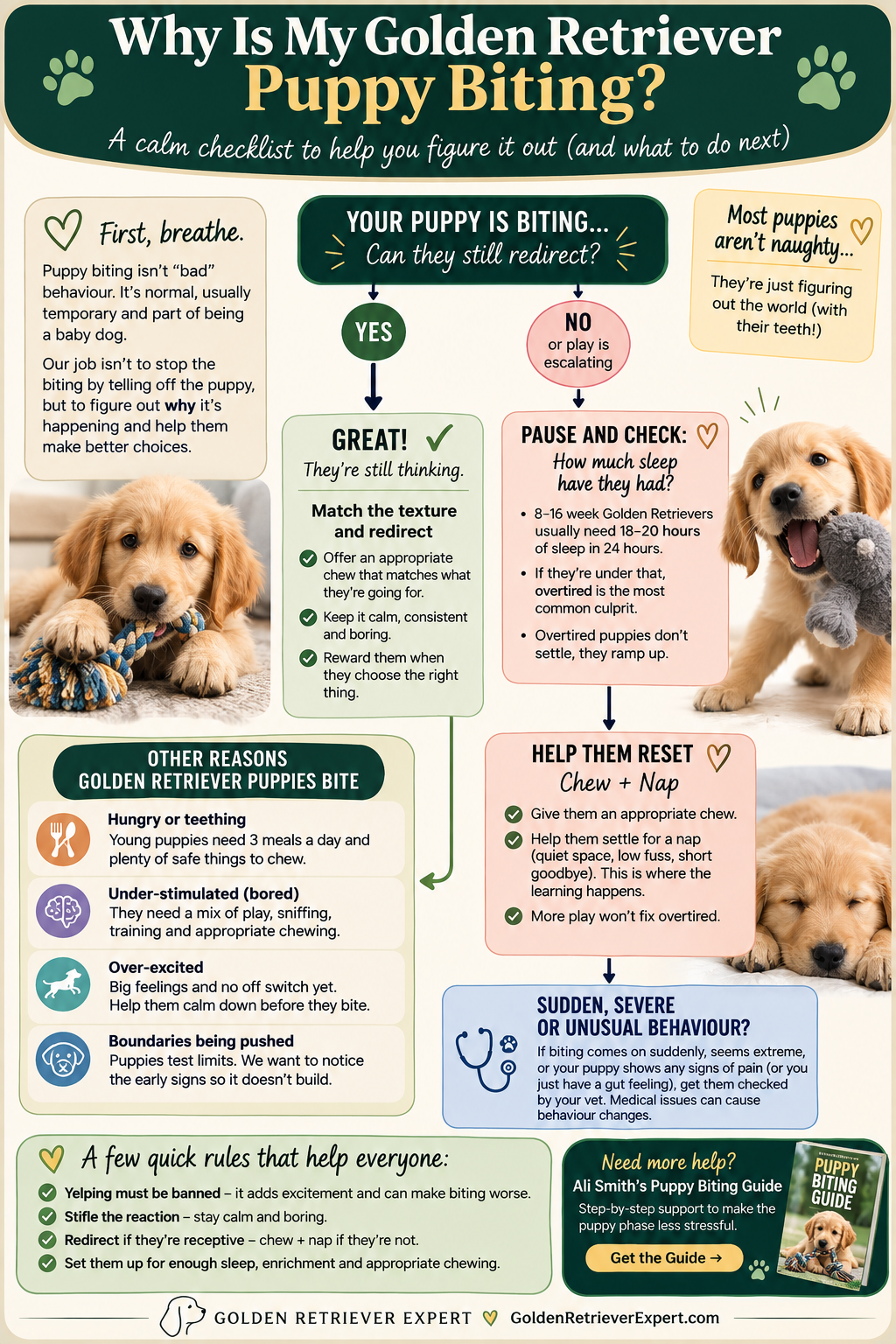
When a Golden puppy becomes increasingly wild, grabby and bitey, it is very easy to conclude that they have excess energy. Owners add another game, another walk or another round of play in the hope of finally wearing the puppy out, when sometimes that is exactly the wrong direction.
“Don’t fall for it,” Ali says. “Sleep is one of the most underrated things for all puppies, but with excitable Golden Retrievers it can be a big issue.” If you’re unsure what enough rest actually looks like at this age, Ali’s Puppy Sleep Schedule on Rebarkable gives an age-by-age framework, and her deeper guide to how much sleep puppies really need explains why an apparently hyper puppy can actually be overtired.
Overtired puppies often don’t look peacefully sleepy. They can look frantic. Their ability to regulate themselves deteriorates, their biting becomes harder and their capacity to respond to training can disappear with it. If your puppy has been awake for a long time and play is escalating rather than improving, think rest before assuming they need more stimulation. Our Golden Retriever puppy sleep and settling guide covers this inability to switch off in much more detail.
This connects with the wider approach in our Golden Retriever Puppy Training: A Complete Guide, where sleep and settling sit alongside the more obvious skills such as recall and leash work.
If They Can Still Think, Redirect the Biting
If your puppy is reasonably calm, has had enough sleep and is receptive to you, redirection is useful. Offer them something appropriate to put their mouth on instead of your hand, clothing or furniture.
There is an important detail here that generic “give them a toy” advice often misses: match the texture.
If your puppy is enthusiastically chewing something soft and fabric-like, a hard chew may not meet the same need. If they are gnawing a firm chair leg, a floppy plush toy may be equally unconvincing. Look at what your puppy chose and offer a safe, appropriate alternative that provides a similar mouth-feel.
As Ali puts it, “Replacing a chair leg with a bone isn’t necessarily going to do it.” The aim is not merely to put an approved object in front of the puppy. It is to give them an alternative that actually works for what they were seeking.
Keep Your Reaction Boring
Puppy teeth hurt, so nobody is going to respond perfectly every time. But dramatic reactions can make biting more exciting for some puppies. Squealing, flapping hands, repeatedly pushing the puppy away or turning the whole event into a chase can add exactly the energy an already excited Golden is looking for.
Keep things as calm and uneventful as you reasonably can. If the puppy can redirect, redirect them. If they are no longer capable of engaging with the alternative and everything is escalating, stop trying to train through the moment and consider whether they need help settling and sleeping.
What Else Can Make Puppy Biting Worse?
Teething is an obvious contributor, so puppies need access to safe and appropriate things to chew. If you’re trying to work out whether those needle teeth are part of normal development, Rebarkable’s Puppy Teething Timeline is a useful companion. Hunger can matter too, particularly with young puppies whose meals are spread through the day. At the other end of the spectrum, boredom and a lack of appropriate enrichment can leave a puppy looking for their own entertainment, while too much exciting activity can push them into the same frantic state as overtiredness.
The useful question isn’t simply “How do I stop the biting?” It is “What is happening around the biting?” Look at sleep, food, teething, enrichment, the type of play that preceded it and whether your puppy is still capable of making another choice. Patterns become much easier to see when you stop treating every bite as the same behaviour.
Golden Retriever Puppy Biting and Toilet Training Often Collide
Those first weeks can feel relentless because the puppy who needs constant supervision for biting is also the puppy you are trying to housetrain. A predictable routine helps both. Sleep, meals, play, toilet opportunities and calmer periods give you a much clearer picture of what your puppy needs at any particular moment.
If accidents are part of the chaos too, our guide to potty training a Golden Retriever puppy walks through Ali’s approach of minimising opportunities for mistakes and rewarding outdoor toileting well.
When Do Golden Retriever Puppies Stop Biting?
There isn’t a date you can circle on the calendar. Puppy biting generally improves as puppies mature, finish teething, develop better regulation and learn what they are supposed to do with their mouths instead. Your management and training matter, but development matters too.
What you want to see is a trend. The puppy should gradually become easier to redirect, better able to settle and more capable of choosing appropriate toys and chews. Expect some messy days along the way, particularly when they are tired, overexcited or going through developmental changes.
Trying to eliminate every use of teeth immediately is likely to make everybody miserable. The more realistic goal is to teach appropriate mouth use while meeting the needs that are driving the behaviour.
When Is Puppy Biting Not Just Normal Puppy Biting?
Most puppy biting is normal, but sudden or unusual behavioural change deserves attention. If biting appears abruptly, becomes markedly different from your puppy’s normal behaviour, happens alongside signs of pain or illness, or you have any reason to suspect a medical problem, speak to your veterinarian rather than assuming it is purely a training issue.
Behaviour also needs to be considered in context. If you are genuinely concerned by the intensity, triggers or body language surrounding your puppy’s biting, getting an individual assessment from an appropriately qualified professional is more useful than trying increasingly forceful internet fixes.
Punishment is not the shortcut it can appear to be. You may suppress a warning or make the interaction more frightening without resolving what caused the behaviour in the first place.
What Should You Do When Your Golden Retriever Puppy Starts Biting?
Start with the puppy in front of you. If they are rested and still capable of thinking, offer an appropriate alternative and match the texture they were seeking. Keep your response low-key, reinforce good choices and make sure they have suitable opportunities for chewing, sniffing, play and enrichment.
If they are becoming increasingly frantic and redirection has stopped working, check how much sleep they have had. More play is not always the answer to an overexcited Golden Retriever puppy. Sometimes the most useful training decision is helping them come down from the excitement and get some rest.
And remember that mouthiness is not evidence that you have a bad Golden Retriever. You have a young retriever learning how to live in a human household, with a mouth that is currently one of their main ways of interacting with the world.
For a much deeper walkthrough of puppy biting and how to troubleshoot it, Ali has created a dedicated Puppy Biting Guide. For more free help, her Rebarkable articles on how to train a puppy not to bite and when puppy biting starts to ease go further into the training and developmental side.
The goal is not to punish the mouth out of your Golden. It is to understand what is driving the behaviour, meet the puppy’s needs and teach them what works instead. With consistency, enough sleep and sensible alternatives, those needle teeth do eventually become a much smaller part of life.