
This article contains affiliate links. If you buy through one of these links, we may earn a commission at no extra cost to you. The recommendations here are based on products and toy types dog trainer Ali Smith genuinely uses and recommends.
Golden Retriever puppies are mouthy. That is not exactly breaking news if you currently have one hanging from your sleeve, but it does mean I’m quite particular about the toys I want available in a Golden puppy household.
I don’t think you need a mountain of toys. I would rather give a puppy a small, useful selection that lets them do different things: carry something soft, retrieve, chew, lick, dissect, chase and settle with an enrichment toy. Goldens are retrievers, after all. Giving them appropriate things to put in their mouth is considerably more realistic than spending six months telling them not to pick anything up.
My core puppy toy kit would include a Fluff & Tuff stuffed toy, a Kong, and an appropriately sized Chuckit ball, with edible or natural chews used separately for chewing and settling.
My top Golden Retriever puppy toys at a glance
| Pick | Best for | Why I like it |
|---|---|---|
| Fluff & Tuff stuffed toy | Carrying, retrieving and soft play | A properly made stuffed toy that suits a retriever beautifully |
| Kong | Food enrichment and settling | Simple, versatile and genuinely useful |
| Large Chuckit ball | Fetch and interactive play | A practical retrieving toy once the size is appropriate |
Best stuffed toy: Fluff & Tuff
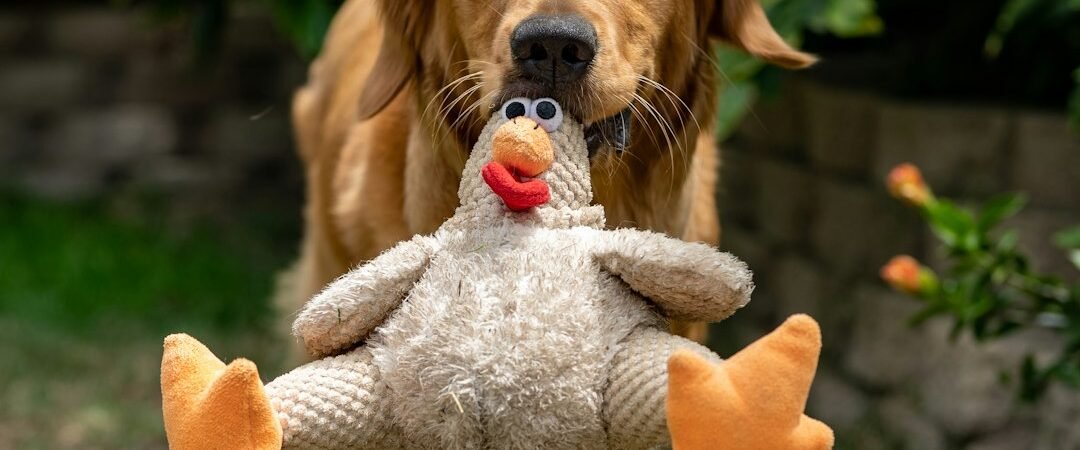
This Fluff & Tuff toy is my favourite stuffed option for a Golden Retriever puppy.
I love Fluff & Tuff toys. Goldens tend to love soft things they can pick up, parade around with and bring back to you, and I would much rather give them a good-quality stuffed toy designed for dogs than act surprised when they decide the sofa cushion looks carryable.
The important bit here is that I’m recommending it as a stuffed toy, not claiming it is indestructible. No soft toy is. Some puppies are remarkably talented at finding seams and removing stuffing, so supervise play and retire a toy when it becomes damaged.
For a retriever, though, soft toys have value beyond simply chewing on them. They give the puppy something pleasant to carry, can become part of gentle retrieve games, and help us work with the behaviour the breed was designed for rather than constantly trying to suppress it.
Best enrichment toy: Kong
A Kong is one of the most useful puppy purchases you can make.
I’m not interested in enrichment toys that require an engineering degree every time you want to use them. The Kong has lasted because it is simple and ridiculously versatile.
You can stuff it with part of your puppy’s normal food, make the contents progressively harder as they learn how it works, use it to encourage quiet independent activity, or give it when you want to help a puppy settle.
The trick is not to make the first Kong impossibly difficult. If your puppy licks it twice, gets nothing and wanders off, we haven’t enriched them; we’ve just given them a confusing rubber object. Start easy and build difficulty as the puppy becomes good at emptying it.
If you want a more structured way to use one, my How to Kong guide walks you through it.
Best fetch toy: Large Chuckit ball
The large Chuckit ball is my Golden-specific fetch pick.
Fetch is an obvious game for a retriever, but I still don’t want endless high-speed ball throwing until the puppy is exhausted. More is not automatically better.
I prefer to make retrieving interactive: short sessions, a little movement, some reinforcement for coming back, and plenty of opportunities for the puppy to do other dog things rather than turning the ball into the only exciting object in the universe.
Size matters too. Use a ball that is appropriately sized for the puppy in front of you and large enough not to present an obvious swallowing risk. As your Golden grows, reassess the toys rather than assuming the puppy-sized collection is still suitable.
What about chews?
Chewing matters enormously for puppies, particularly through teething, but I think it is clearer to separate chews from toys. A stuffed dog toy, a fetch ball and an edible chew do different jobs.
Useful options in my enrichment cupboard include yak cheese, bully sticks, coffee root chews, pig ears and buffalo horn.
That does not mean every chew is appropriate for every puppy. Supervise, choose a size appropriate to the dog, watch how your individual puppy chews, and remove anything that has become small enough to swallow or is breaking in a way you’re not comfortable with.
Your puppy does not need twenty toys
One of the easiest puppy-shopping traps is buying everything before the puppy even comes home. Then you have a basket overflowing with objects while the puppy is delightedly carrying your slipper.
I’d start with variety rather than quantity. Give them something soft to carry, something food-based to work on, something suitable for interactive retrieving and appropriate chewing options. Then watch the puppy you actually have.
Some Goldens adore plush toys. Some become obsessive little surgeons. Some love balls. Some would rather carry something around than chase it. Their preferences are useful information, and toys work better when we give the dog some agency in what play looks like.
Can toys help with Golden Retriever puppy biting?
Yes, but I don’t mean repeatedly shoving a toy into a puppy’s mouth every time their teeth touch you.
Golden puppies explore with their mouths, teething adds another layer, and tired or over-aroused puppies can become particularly bitey. Having good legal outlets absolutely helps, but biting also needs us to look at sleep, arousal, interaction, environment and what is happening immediately before the behaviour.
Our Golden Retriever puppy biting guide goes into that properly rather than pretending one chew toy fixes the whole problem.
Use toys to build skills, not just tire your puppy out
Toys are brilliant training tools when we stop thinking of them purely as puppy entertainment. A retrieve can build engagement and reinforce returning to you. A stuffed toy can give a mouthy puppy an appropriate thing to carry. A Kong can help practise settling and independence. Even swapping toys can become the beginning of a really useful drop or trade behaviour.
That fits into the broader approach in our Golden Retriever puppy training guide: we’re not trying to control every puppy behaviour. We’re showing them which choices work in a human household while still letting them be a dog.
How I choose toys for a Golden Retriever puppy
- Appropriate size: big enough that I’m not worried about the puppy swallowing it.
- A useful purpose: carrying, retrieving, enrichment, chewing or interactive play.
- Construction: sensible materials and no obvious weak points for the way that particular puppy plays.
- Supervision needs: I assume puppies can surprise me. A toy that is fine for interactive play may not be something I leave down unattended.
- The puppy’s preference: if your puppy clearly loves carrying soft toys, that is useful information. I’m not going to insist they become a ball fanatic because they happen to be a retriever.
Should toys be left out all day?
Some can be, depending on the puppy and the toy, but I like having at least a few things that retain some novelty because they come out for interaction with you.
I’m also cautious about leaving anything with a puppy unsupervised until I know how that individual uses it. One Golden may gently carry a plush toy for months; another can open it in three minutes. The label on the toy tells you less than watching your puppy does.
My starter toy kit for a Golden Retriever puppy
If I were bringing home a Golden puppy tomorrow, I would keep the initial shopping list surprisingly short:
- One good Fluff & Tuff stuffed toy for carrying and gentle retrieving
- A Kong for food enrichment and settling
- An appropriately sized Chuckit ball for interactive retrieve games
- A couple of suitable chew options, chosen for the individual puppy
Then I’d spend the rest of the budget on the things puppies actually need: good management, appropriate rest, training and socialisation.
If you want the wider puppy setup rather than buying everything piecemeal, my Puppy Bundle brings the training resources together, and the Socialisation eBook covers one of the most important jobs you’ll be doing during those early weeks.
What to do when your Golden puppy bites you instead of the toy
A puppy who grabs hands, sleeves or trouser legs isn’t necessarily short of toys. Overexcitement, tiredness, frustration and the simple pleasure of grabbing moving fabric can all contribute. Rather than waving a toy in an already frantic puppy’s face, reduce stimulation, create a calm pause and help them get the sleep or space they need. Use management to prevent repeated rehearsals of painful biting.
The Rebarkable Puppy Biting Guide gives a more detailed training plan, while the Puppy Schedule Builder helps you build a routine around rest and activity. If you want to use your KONG for quiet enrichment, the KONG stuffing guide supplies straightforward ideas without needing to buy a mountain of different toys.
The bottom line
Golden Retriever puppies do not need the biggest toy box. They need good outlets for the things puppies naturally want to do.
For me, the essentials are a quality soft toy they can carry, a Kong for enrichment, a sensible fetch toy and a few appropriate chewing options. My standout stuffed choice is Fluff & Tuff because it fits the way retrievers tend to enjoy using their mouths: carrying, retrieving and interacting with something soft.
Buy a few good things, supervise while you learn how your puppy plays, and let their preferences tell you what is worth adding next.